Einhell TC-VC 1812 S Wet and Dry Vacuum Review
Introduction: A Water and Dust Vacuum, But For Your Indoor Air Health?
In our quest for a healthy home, we often focus on air purifiers and vacuums with high-performance filters. But what about major cleaning tasks, household accidents, or deep cleaning after renovations? This is the niche where the Einhell TC-VC 1812 S positions itself: a so-called "wet and dry" vacuum cleaner. On our site dedicated to healthy cleaning, we must ask ourselves: is this tool designed for moisture and debris an ally or a disruptor for our indoor air quality? Can it be integrated into a comprehensive approach to reducing pollutants, or is it strictly confined to occasional, noisy tasks?
In this comprehensive analysis, we will break down its specifications, its real-world performance based on community and expert feedback, and above all, we will evaluate it from the angle that matters to us: its impact on your indoor environment. Can it capture allergens? Is its filtration system suitable? Is its use compatible with a home where one seeks to preserve healthy air? Let's see.
Strengths and Weaknesses: A Clear Summary
Before going into detail, here is a synthetic overview of the strengths and limitations of the Einhell TC-VC 1812 S, as they emerge from user feedback and technical analyses.
What we remember positively
- Practical versatility: Its ability to vacuum both water and dry dust, from fine debris to stagnant water, makes it a very useful tool for accidents, small jobs, or cleaning basements/garages.
- Power and blower function: The 1250 W motor is widely recognized as powerful enough for domestic and light DIY uses. The integrated blower function is a valued feature for dislodging dust from corners.
- Appreciated maneuverability: Weighing about 2.9 kg empty and with its four wheels, it is described as easy to move. Its 12L stainless steel tank is also considered easy to empty and clean.
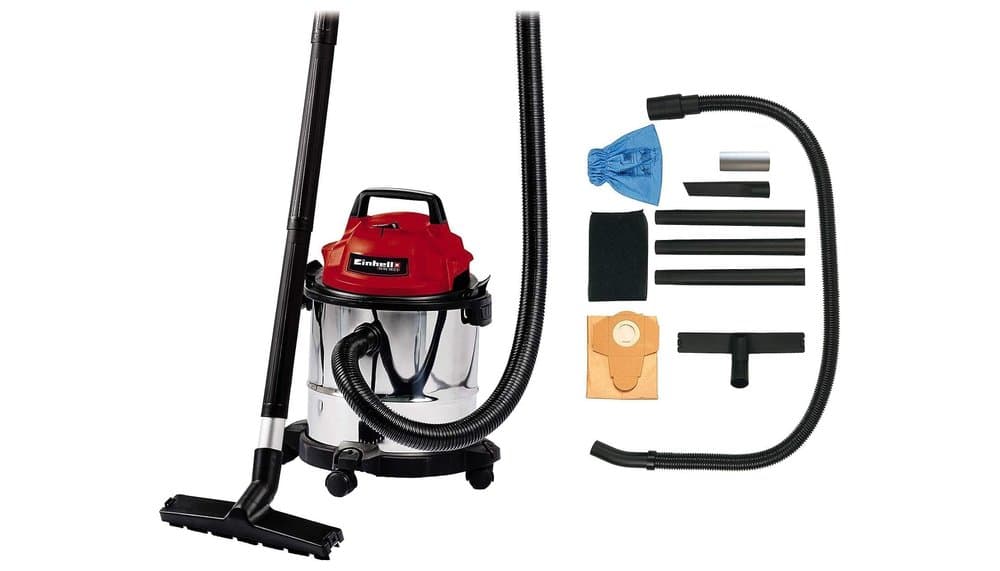
- Perceived value for money: For occasional or moderate use, the community often considers it a good investment, complete with its accessories (combination nozzle, flat suction head, hoses).
What raises questions for "healthy" use
- Basic filtration and risk of re-emission: This is the critical point. It is equipped with a simple foam filter for liquid mode and a paper dust bag (supplied) for dry mode. It is not equipped with a HEPA filter, nor activated carbon. This means it retains coarse dust and water, but very likely releases fine particles, allergens (dust mites, pollen) and mold spores into the expelled air.
- High noise level: Rated at 80 dB, this level is confirmed by users. This volume makes the device unsuitable for use in the presence of babies, people sensitive to noise, or for continuous cleaning in living areas without causing disturbance.
- Build quality and durability: Feedback notes that some parts, like plastic connectors or wheels, can seem fragile and require careful handling. It is not a tool designed for intensive industrial use.
- Limited cable length: With only 2.5 meters of cable, an extension cord is almost essential to cover a standard room, which adds a practical inconvenience.
Detailed Analysis from a Health and Air Quality Angle
The filtration system: the great absentee from the "allergen-free" approach
This is the central element of our analysis. The Einhell TC-VC 1812 S is a "containment" vacuum, not an "advanced filtration" one. Its role is to capture and contain visible debris and liquids, not to purify the ambient air.
- For dry dust: It primarily uses a paper filter bag. This bag retains coarse and medium dust. However, the finest particles (PM2.5, PM10), allergens like dust mite droppings or pollen, and some mold spores can pass through this filter media and be released into the room air through the device's exhaust. If you suffer from respiratory allergies or asthma, using this appliance in dry mode can therefore temporarily worsen particulate pollution in the air. It does not in any way replace a vacuum equipped with a HEPA H13 or H14 filter, which guarantees retention of at least 99.95% of 0.3 micron particles.
- For liquids and wet dust: The foam filter (to be installed in place of the bag) primarily protects the motor from moisture. It plays no role in disinfection or elimination of bacteria. If you vacuum dirty water (e.g., basement water, spilled liquid), the microbes and pathogens present will simply be transferred to the tank. No UV-C light or sterilization system is integrated.
- Absence of activated carbon filter: The appliance is not designed to capture Volatile Organic Compounds (VOCs), paint odors, chemical smells, or mold odors. These gaseous pollutants will simply be circulated by the airflow.
Conclusion on filtration: The TC-VC 1812 S is effective for mechanical cleaning of large volume debris (rubble, water, sawdust). On the other hand, for everything related to indoor air hygiene, combating allergens and microparticles, it is completely ineffective and can even be counterproductive. Its use requires proper ventilation of the room after dry-mode use.
Noise level: A noisy companion to be reserved for appropriate times
The announced noise level of 80 decibels (dB) is corroborated by almost all feedback. To give you an idea, 80 dB corresponds to the noise of a busy street or a loud conventional vacuum cleaner. This characteristic makes it unsuitable for indoor use when a person is sleeping, in a baby's room, or if you seek a quiet environment. It is a device designed for occasional, short cleaning sessions, in low-occupancy areas (garage, workshop, basement) or when the home is empty.
Versatility and practical performance: where it excels
Outside the field of air purification, its performance is praised for specific tasks:
- Water suction: Users confirm its effectiveness for emptying small puddles, aquariums, or sucking up water after a leak. The 12L stainless steel tank is an asset, even though it fills quickly with large volumes.
- Construction dust suction: Coupled with a sander (thanks to its integrated socket for automatic start-up, a highly appreciated feature noted by testers), it effectively captures sawdust and plaster or sanding dust, thus preventing their dispersion in the workshop air. This is its main "health" interest here: better to have this dust in the tank than in your lungs.
- Blower function: Useful for cleaning corners, radiators, or tools before storing them, this function can help dislodge dust before vacuuming it with a more suitable appliance (like a HEPA vacuum). Used alone, it inevitably stirs up dust into the air.
Ease of maintenance and consumable costs
Maintenance seems simple: emptying the tank, rinsing the foam filter, replacing the paper bag. The durability of consumables (bags, foam filters) is a point to watch. According to feedback, for intensive use with fine dust (like sawdust), the standard paper bag can clog quickly. Some users recommend using more durable fabric bags. The cost of these replacement consumables should be considered in the long term, although generally moderate for this category of appliance.
Technical Specifications
| Characteristic | Detail |
|---|---|
| Appliance Type | Wet and dry vacuum cleaner (canister) |
| Motor Power | 1250 W |
| Suction Power | 180 mbar |
| Tank Capacity | 12 Liters |
| Tank Material | Stainless Steel |
| Noise Level | ~80 dB |
| Cable Length | 2.5 meters |
| Hose Length | 1.5 meters |
| Features | Dry/wet suction, blower function |
| Main Filtration | Dust bag (paper) for dry / Foam filter for wet |
| Advanced Filtration | None (No HEPA filter, no activated carbon, no UV-C) |
| Included Accessories | Suction hose, 3 extension tubes, large combination nozzle, flat suction head, adapter, foam filter, 1 dust bag. |
| Weight | Approximately 2.9 kg (empty) |
| Mobility | 4 wheels, carrying handle |
What Users Say: Summary of Community Feedback
Analyzing thousands of reviews gives a consistent and nuanced picture of the TC-VC 1812 S.
The recurring positive points revolve around satisfaction for the price paid. Users praise its power deemed sufficient, its versatility (vacuuming water after minor flooding, sawdust from sanding, wet leaves), and its maneuverability. The blower function is often cited as a very practical bonus. Many find it perfect for occasional DIY use, for the car, or garage cleaning.
The most frequent criticisms concern:
- Noise: Almost unanimously described as high, limiting its use to opportune moments.
- Quality of some components: The plastic connectors are sometimes judged as fragile, the wheels may lack sturdiness, and the cable is too short for many.
- Limited filtration: Several users point out the need to change/empty the bag/filter often during intensive fine dust use, confirming the system's limit for the lightest particles.
- Variable performance: A minority of buyers reported issues with rapid loss of suction, often linked, according to other reviews, to a clogged filter bag or improper filter assembly.
Expert opinion (DIY forums, online tests) aligns with this analysis: it is a good backup tool, robust for amateur and intermittent use, but it does not pretend to rival professional equipment or everyday vacuums dedicated to air quality.
Conclusion: A Jobsite Tool, Not a Daily Ally for Healthy Air
The Einhell TC-VC 1812 S finds its perfect place in a garage, basement, or shed, ready to intervene for water damage, sanding, or car cleaning. Its versatility, power, and maneuverability make it an excellent companion for tasks and household accidents.
However, it must not be considered a tool contributing to improved indoor air quality in the sense we mean. Its basic filtration system, the total absence of a HEPA filter, and its significant noise level disqualify it for use in living areas in the presence of occupants, especially if they are sensitive to allergens or seek a calm and healthy environment.
Our final recommendation is clear: Use the Einhell TC-VC 1812 S for what it does best: contain and remove large debris and liquids. For the regular cleaning of your floors, carpets, and surfaces, and to effectively combat dust mites, pollen, and fine particles, you must turn to a vacuum equipped with a sealed HEPA filter (H13 or H14) and, ideally, an activated carbon filter for odors. These two appliances are complementary but their roles must not be confused. One is a demolition tool for big jobs, the other is the daily guardian of your air.
Independent and transparent — Our articles are based on in-depth research and real user reviews. No brand sponsors our content. Affiliate links help fund the site, at no extra cost to you.
Articles you might like
Rowenta Steam Power RY6597WH Steam Cleaner Review
Review: Rowenta Steam Power All Floors cleaner. Chemical-free deep cleaning & disinfection for hard floors & textiles via high-temperature steam.
Lefant M3 Max Review: Ultimate Robot Vacuum & Mop
Lefant M3 Max: A robot vacuum and mop duo with a self-cleaning station for a powerful, hands-free clean. Promises efficiency for a dust-free home.
NNOVAT Puff Chill Smoking Fan Portable Air Purifier Review
Compact portable air purifier for smoke & odors. Filters air in real-time like a table fan.
Guides you might like
Air Purifier Buying Guide
Indoor air can be more polluted than outside. Learn how to choose the right air purifier to combat dust, VOCs, and allergens.
Allergen Fighter Dehumidifier Buying Guide
Combat allergies from dust mites and mold caused by high humidity at home. A good dehumidifier protects your family's health.
Anti-allergen vacuum cleaner
Does vacuuming worsen allergies? Yes, with a poor filter. Choose the right vacuum to trap allergens and protect your health.