Extech VFM200 VOC and Formaldehyde Analyzer Test and Review
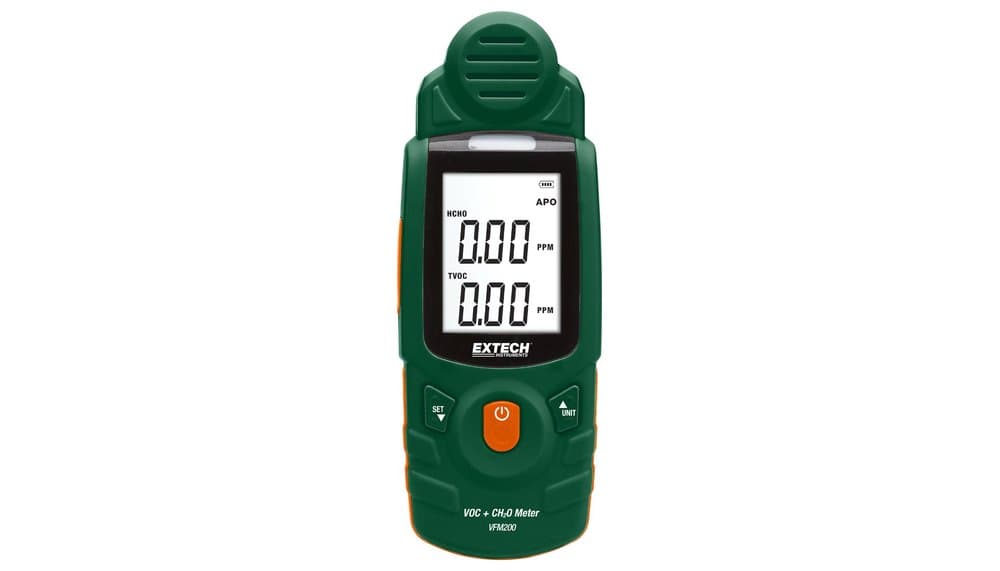
Complete Analysis: The Extech VFM200, A Professional Eye on Your Indoor Air
In our quest for a healthy indoor environment, we often spend energy and resources purifying the air: HEPA filters, activated carbon, all sorts of purifiers. But how do we know what we are really fighting? The invisible is our worst enemy. This is where the Extech VFM200 VOC and Formaldehyde Analyzer Indoor Air Quality Monitor comes in. This analyzer promises to make the invisible visible, by accurately measuring two of the most problematic pollutants in our homes: total VOCs and formaldehyde. We will dissect this technical device to understand if it can be the objective and scientific ally for a household concerned about its health.
What interests us here is its ability to transform vague concerns into concrete data. Before investing in solutions, shouldn't we first establish a reliable diagnosis?
Strong Points
The Extech VFM200 stands out through several characteristics that make it a serious diagnostic tool, well beyond consumer electronic gadgets.
Versatility and comprehensiveness of measurements: This is its main strength. The device is not limited to a single indicator. It measures simultaneously total VOCs (TVOC) and specific formaldehyde (HCHO), two families of pollutants with distinct sources. Additionally, it integrates sensors for CO₂, relative humidity, temperature, dew point, and wet-bulb temperature. This holistic approach is valuable because it provides a complete overview of the indoor environment. A CO₂ spike can indicate insufficient air renewal, while high humidity can promote mold, a different problem from VOCs.
Professional-grade sensor technology: The device uses an electrochemical fuel cell for formaldehyde and NDIR sensors for CO₂. These technologies, commonly used in professional instrumentation, are known for their reliability and long-term stability. On paper, the specifications announce distinct measurement of formaldehyde, which is a major advantage compared to cheaper MOS (metal-oxide semiconductor) sensors which often confuse HCHO with other gases and are sensitive to humidity variations.
Design oriented towards diagnosis and monitoring: The Extech VFM200 is designed for analysis. Its color screen clearly displays several parameters at once. Its built-in data logger function, with included SD card, allows the recording of thousands of timestamped data points. For us, this means the ability to identify patterns: Do VOCs increase after cleaning? Is formaldehyde higher at night in the bedroom? It's a powerful tool for pinpointing the source of problems.
Portability and autonomy: Compact and operating on batteries (eight AA batteries included) or via mains power with a universal charger, it is designed to be moved from room to room. This allows for mapping air quality throughout the house, identifying the most problematic rooms, and verifying the effectiveness of an action (like ventilating after using a cleaner).
Weak Points
Despite its technical strengths, the Extech VFM200 has significant limitations, especially from a long-term domestic use perspective.
Sensor with limited, non-replaceable lifespan: This is its most crucial flaw, confirmed by the analysis of technical documents. The electrochemical sensor for formaldehyde has a typical lifespan of 3 to 5 years. Once this period elapses, the sensor degrades and the entire device potentially becomes unusable or unreliable. For an investment of this level, this planned obsolescence is a hard pill to swallow. This destines it more for occasional professional use or for diagnosis over several months rather than for permanent monitoring over a decade.
Complexity and data interpretation: This device is first and foremost a measurement tool, not a health coach. It provides raw numbers (in ppm or mg/m³) but does not always interpret them simply for the general public. For example, a level of 0.08 ppm of formaldehyde: is it concerning? The user community notes that one must refer to health guidelines (like those from the WHO or ANSES) to contextualize the results. There is no simplified rating system like "good/medium/bad air" as found on some consumer monitors.
Questionable accuracy at low concentrations: Several user feedbacks, particularly in customer reviews, point to a perceived inaccuracy at low concentration levels. One user compared readings with other detectors and found discrepancies, especially for low levels of VOCs and formaldehyde. Although the datasheet states an accuracy of ±5% of full scale, this margin can be significant when trying to measure levels close to recommended health thresholds, which are themselves very low.
Detailed Analysis from a Health and Air Quality Perspective
For our community focused on a healthy habitat, let's evaluate what the Extech VFM200 truly brings to the table.
Which pollutants does it actually target? The device is specifically designed for volatile organic compounds (VOCs) and formaldehyde (HCHO). Total VOCs represent a chemical soup emanating from paints, new furniture, cleaning products (even the ones we avoid), air fresheners, construction materials. Formaldehyde, a classified carcinogen, is a particularly persistent specific VOC, coming from the glues in particleboard, insulating foams, and certain textiles. The ability to measure them separately is a decisive advantage. The CO₂ sensor is an excellent indicator of air renewal: a rising level signals insufficient ventilation, which can intensify the feeling of stuffiness and the concentration of other pollutants.
What is the real measurement effectiveness? Based on community feedback and specifications, the Extech VFM200 excels in trend detection and source identification. Its fast response time (less than 2 seconds) allows you to immediately see the impact of an action: opening a window, turning on the range hood, using a steam cleaner (which, without chemicals, should not increase VOCs). Its role is not to "filter" but to reveal. It shows you, for example, that your new furniture or carpet releases compounds for weeks, or that your office air becomes stuffy mid-afternoon. It's a form of radical effectiveness: that of diagnosis.
Compatibility with a "chemical-free" approach: This analyzer is the perfect tool to validate the effectiveness of your approach. By using a steam cleaner, you eliminate bacteria through temperature, without VOCs. The Extech VFM200 can theoretically confirm this by not showing a VOC spike during cleaning. Similarly, if you use an air purifier with an activated carbon filter (effective against some VOCs and odors), you can monitor if total VOC levels decrease in the room. It thus becomes the arbiter of your healthy equipment.
Noise level and domestic use: The device is silent in standard operation. It emits an adjustable audible alarm if a threshold is exceeded. It can therefore perfectly be used continuously in a bedroom or baby's room without disturbing sleep. Its backlit screen can be turned off to avoid any disturbing light.
Key Technical Specifications
| Parameter | Detail |
|---|---|
| Measured Pollutants | Total VOCs (TVOC), Formaldehyde (HCHO), Carbon Dioxide (CO₂) |
| Environmental Parameters | Temperature, Relative Humidity, Dew Point, Wet Bulb Temperature |
| Sensor Technology | Electrochemical Sensor (HCHO), NDIR Sensor (CO₂) |
| Display | Backlit Color LCD Screen |
| Autonomy / Power Supply | 8 AA Batteries (included) or Universal 100-240V AC Adapter (included) |
| Sensor Lifespan | Approximately 3 to 5 years (HCHO sensor non-replaceable) |
| Data Logging | Built-in Data Logger with SD Card (included) |
| Portability | Compact (25 x 13 x 8 cm), lightweight (0.1 kg) |
| Warranty | 1 Year |
What Users and Experts Say
The synthesis of customer reviews and available technical analyses paints a nuanced but illuminating consensus.
Recurring positive points:
- Perceived Accuracy and Responsiveness: Many users, especially on technical forums, appreciate its ability to quickly detect pollution sources. They report VOC spikes near cleaning products, new materials, or during cooking, validating its sensitivity.
- Highly Valued Multivalence: The simultaneous measurement of formaldehyde, VOCs, and CO₂ is widely praised as a major advantage compared to single-sensor monitors.
- Indispensable Data Logger Function: Savvy users praise this professional feature which enables long-term analysis, far beyond simple instant reading.
Frequent criticisms and reservations:
- Long-Term Reliability: The issue of the limited lifespan of the main sensor is raised as a major design flaw for this type of investment.
- Learning Curve: Some buyers find the device complex to set up initially (alarm settings, unit interpretation) and regret the lack of a simplified guide for interpreting results for health.
- Accuracy at Low Levels: As mentioned, several feedbacks question the accuracy of measurements at low concentrations, crucial for assessing a healthy domestic environment. One user even called it an "overpriced toy", perhaps expecting laboratory-grade precision.
- Mixed Value for Money: This sentiment appears in reviews; for some, it's a professional tool justifying its cost, for others, the limitations (non-replaceable sensor, complexity) make it less convincing for purely domestic and permanent use.
Conclusion
The Extech VFM200 VOC and Formaldehyde Analyzer is a powerful and serious diagnostic tool, much closer to professional instrumentation than a connected gadget. For those who want to accurately and objectively understand the composition of their home's air, identify specific sources of pollution (like a formaldehyde-emitting piece of furniture), and document the impact of their actions (ventilation, purification), it is unmatched in its category.
However, it requires a certain intellectual investment to be fully utilized and involves a major compromise: its useful life is limited by that of its main sensor. It may not be the device to leave permanently switched on for 10 years on your nightstand, but it is the ultimate diagnostic tool to use for a few months to audit your home, validate your purification solutions, and take informed control of your indoor environment.
In summary, if you are looking for a scientific partner to transform the invisible into actionable data, the Extech VFM200 is a strong contender. But approach it as a connoisseur, aware of both its technical strengths and its constrained lifecycle.
Independent and transparent — Our articles are based on in-depth research and real user reviews. No brand sponsors our content. Affiliate links help fund the site, at no extra cost to you.
Articles you might like

Veegreen White Sage and Palo Santo Incense Set Review
Review the traditional ritual of smudging with white sage and palo santo for cleansing air naturally, as an alternative to modern air purifiers.
NOVEMBER Sirius Mattress Review: Complete Test Analysis
A deep analysis of the NOVEMBER Sirius mattress for healthy sleep. We test its materials and construction for allergens, VOCs, and overall sleep hygiene.
Pro Breeze OmniDry D 12L Dehumidifier Review
Eliminate humidity, allergens, and mold with the Pro Breeze OmniDry Dehumidifier. Discover how it improves air quality for a healthier, chemical-free home.
Guides you might like
Air Purifier Buying Guide
Indoor air can be more polluted than outside. Learn how to choose the right air purifier to combat dust, VOCs, and allergens.

Allergen Fighter Dehumidifier Buying Guide
Combat allergies from dust mites and mold caused by high humidity at home. A good dehumidifier protects your family's health.

Anti-allergen vacuum cleaner
Does vacuuming worsen allergies? Yes, with a poor filter. Choose the right vacuum to trap allergens and protect your health.