INKBIRDPLUS Portable CO2 Detector Air Quality Monitor Review
Introduction
In our quest for healthy and pure indoor air, we often equip ourselves with purifiers, humidifiers, or dehumidifiers. But how can we know if these efforts are sufficient? An invisible, odorless pollutant that is very revealing of our air quality is often overlooked: carbon dioxide (CO2). This is where a diagnostic tool like the INKBIRDPLUS Portable CO2 Detector Air Quality Monitor comes in. It does not purify the air, but it gives you the essential information to act at the right time: when to ventilate? When to check the ventilation in a room where children sleep?
This small black box presents itself as an indicator of our collective breathing and the quality of air renewal. In this article, we will dissect its features, analyze what it really brings to your healthy home ecosystem, and decipher community feedback to help you determine if this detector is the missing piece in your approach to home well-being.
Key Strengths
Analysis of the specifications and user feedback highlights several major strengths of this detector.
NDIR Technology for Reliable Measurement: This is the central point. The INKBIRDPLUS uses an NDIR (Non-Dispersive Infrared) sensor. According to experts in air metrology, this technology is considered more accurate and stable than cheaper chemical sensors (like MOx sensors). It is less sensitive to drift over time and interference from other gases. On paper, this specification is a mark of seriousness.
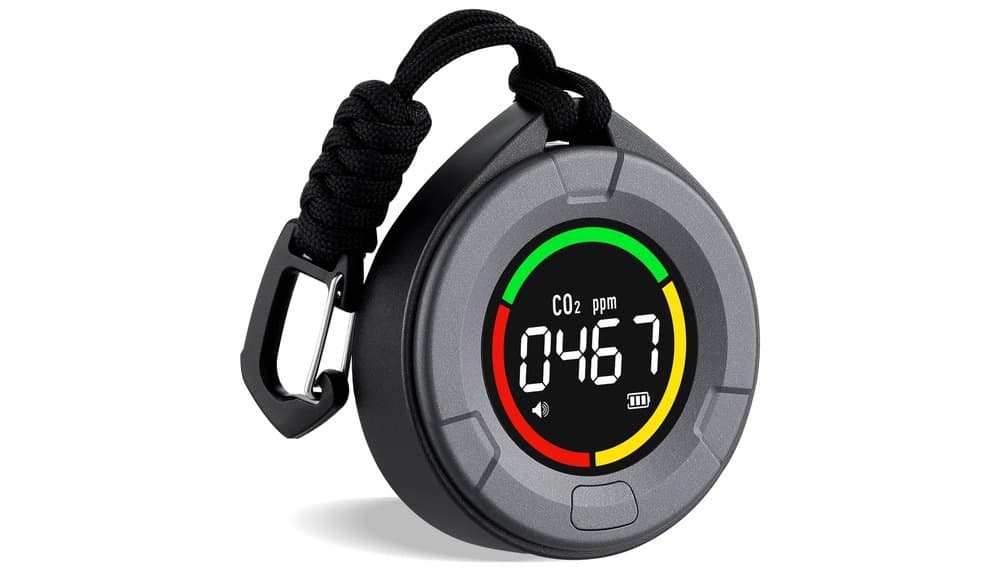
An Intuitive Visual and Audible Indicator: The device translates abstract numbers into clear information. A color code (green, yellow, red) on the screen gives an instant status of the situation. Coupled with an adjustable audible alarm (default threshold at 1500 ppm), it becomes a tool for passive vigilance. You don't need to constantly stare at the screen; the device alerts you if the air deteriorates.
Appreciable Battery Life and Portability: With its integrated 1000mAh battery offering about 72 hours of battery life according to the manufacturer, and its compact size (7x7x2.5 cm), it is a truly nomadic tool. The community notes that it is easy to move from the bedroom to the living room, take it to the office, or even bring it in the camper van to check ventilation. USB-C charging is also seen as a convenient point.
Remarkable Ease of Use: Users unanimously praise the easy setup. Turn it on, let the automatic calibration do its work (or perform a quick manual calibration outdoors), and you're ready to go. The LCD screen is described as readable and the single-button interface avoids any confusion.
Weak Points
No product is perfect, and analyzing the feedback highlights some limitations.
Dedicated Solely to CO2: It is crucial to understand what this device does not do. It measures neither fine particles (PM2.5), nor VOCs (Volatile Organic Compounds), nor humidity, nor temperature. It is a CO2 specialist. For a comprehensive view of air quality, it will need to be paired with other sensors. It does not in any way replace an air purifier with a HEPA filter for allergens.
Long-Term Durability in Question: Some isolated but recurring feedback reports failures after 12 to 18 months (faulty central button, loss of battery capacity). This raises the question of long-term robustness. However, these opinions are in the minority compared to the majority of satisfied users over a similar period.
Lack of Connectivity and History: The device is "dumb" in the good sense of the term, but also in its limitation. There is no Bluetooth connection, Wi-Fi, or app to record data, view trend curves, or receive remote alerts. Data is instantaneous and not saved.
Absolute Accuracy Difficult to Verify: As one user points out, without a professional reference instrument alongside, it is difficult to guarantee the absolute accuracy of the displayed numbers. However, the community notes consistency and responsiveness in the measurements: values rise when people are in a closed room and drop quickly upon ventilation, which is the expected behavior of a good detector.
Detailed Analysis: A Tool for Awareness More Than Purification
Why Measuring CO2 is Crucial for a Healthy Home?
CO2 is not a toxic pollutant at low doses, but an excellent indirect indicator. A high concentration of CO2 (above 1000-1200 ppm) signals stale, inadequately renewed air. In this confined air, the following also accumulate:
- VOCs emitted by furniture, cleaning products (even natural ones, some emit terpenes).
- Allergens like dust mites, pet dander.
- Exhaled humidity, which can promote mold.
- Airborne pathogens (viruses, bacteria).
Thus, a CO2 detector like the INKBIRDPLUS alerts you to the need to ventilate, the simplest, most effective, and economical measure to improve indoor air quality. It also validates the effectiveness of your MVHR (Mechanical Ventilation with Heat Recovery).
Interface and Daily Use: Simplified Science
The device excels in translating complex data into simple signals. The green light (400-699 ppm) reassures you: the air is fresh, close to outside air. The yellow light (700-1499 ppm) calls for vigilance, especially if several people are in the room or in the presence of a baby. The red light and alarm (>1500 ppm) are a clear signal to ventilate immediately. For use in a bedroom, you can even, as testers mention, set the alarm to a lower threshold (e.g., 1000 ppm) for optimal prevention. Its sound level, according to feedback, is sufficient to be heard without being deafening.
Limitations in the "Healthy Home" Ecosystem
In our philosophy of a home without aggressive chemicals, this detector is an information supplement, not a treatment solution. It will not tell you if your HEPA purifier is working well against pollen, nor if your steam cleaner has eliminated dust mites. However, it will tell you if, after steam cleaning in a closed room, the air has become stale and needs renewal. It is this synergy of information and action that is valuable.
INKBIRDPLUS Portable CO2 Detector Specifications
| Specification | Detail |
|---|---|
| Pollutant Measured | Carbon Dioxide (CO2) only |
| Sensor Technology | NDIR sensor (Non-Dispersive Infrared) |
| Measurement Range | 400 - 5000 ppm (parts per million) |
| Accuracy | Not specified in detail, technology known to be stable |
| Display | Color LCD screen with color code (Green/Yellow/Red) |
| Alarm | Audible and visual alarm, customizable threshold (default: 1500 ppm) |
| Battery Life | 1000mAh Li-Po battery, ~72h (estimated), USB-C recharge |
| Calibration | Automatic and Manual (recommended outdoors on first use) |
| Connectivity | None (no Bluetooth, no Wi-Fi) |
| Dimensions & Weight | 7 x 7 x 2.5 cm, ~20 grams |
| Power Supply | 5V via USB-C / Integrated battery |
| Included Accessories | Carrying strap |
What Users Say: A Very Positive Trend, with Caveats
A synthesis of 190 reviews (overall rating of 4.1/5) and expert feedback online reveals a strong consensus, with some constructive criticism.
The Praises (Majority):
- Simplicity and Effectiveness: The terms "simple", "easy to use", "intuitive" come up constantly. Users appreciate the automatic calibration and clear display.
- Sensor Responsiveness: Many note that the device reacts quickly (in 30 seconds to a few minutes) to changes: "It is responsive to CO2 change", "values drop quickly when ventilating".
- Appreciated Portability: Its small size and the included strap make it a tool used in various rooms, at the office, in the car, or in a camper van.
- Usefulness for Ventilation: Many buyers emphasize that it changed their habits: "I realize how quickly the air degrades in the living room", "It tells me when to open the windows, even when we don't realize it ourselves".
Criticisms and Warnings (Minority but present):
- Uncertain Durability: A few testimonies report failures after one year to a year and a half of use (button, battery). This invites considering this product as a potentially limited-lifespan tool.
- Possible False Alarms: One user reports untimely alarms at work (perhaps near a heat source or in a specific environment), highlighting the importance of the initial calibration in clean air as recommended.
- Lack of Historical Data: The absence of data logging is a drawback for the more tech-savvy or those wanting precise analysis over several days.
- Relative Battery Life: The "72-hour" battery life is sometimes perceived as average, but the ability to use it plugged in continuously compensates for this point.
Conclusion: A Valuable Diagnostic Tool for a Healthy Home
The INKBIRDPLUS Portable CO2 Detector Air Quality Monitor is not a purifier, but it is just as important: it is a diagnostician. It fills a crucial gap in our approach to indoor air quality by objectifying a key parameter, CO2, which is the cornerstone of renewed air.
For us, advocates of a healthy home, it is the ally that validates the effectiveness of our most basic and healthiest actions: ventilating. It is particularly relevant for monitoring rooms where we spend a lot of time without realizing it: bedrooms (especially children's), the office, or teleworking spaces.
Its main asset is its perceived reliability, thanks to the NDIR sensor and its responsiveness confirmed by users. Its limitations – exclusive CO2 measurement, lack of connectivity, and questions about its longevity – must be weighed against its precise role and accessibility.
In summary, if you are looking for a simple, portable, and effective tool to become aware of your home's ventilation and adapt your airing habits, this INKBIRDPLUS detector is a sensible investment. It does not clean the air, but it gives you the essential signal to do it naturally, by opening your windows. It is an informed and concrete first step towards a truly breathable interior.
Independent and transparent — Our articles are based on in-depth research and real user reviews. No brand sponsors our content. Affiliate links help fund the site, at no extra cost to you.
Articles you might like
VersLife L6 Robot Vacuum and Mop Review
VersLife L6 robot vacuum & mop review: Can this smart cleaner improve home hygiene without harsh chemicals? Analysis of its health benefits.
Chicco Humi Hot Advance Air Humidifier Review
Chicco Humi Hot Advance Air humidifier review for kids: warm steam relief for seasonal discomforts in a chemical-free home.

Veegreen White Sage and Palo Santo Incense Set Review
Review the traditional ritual of smudging with white sage and palo santo for cleansing air naturally, as an alternative to modern air purifiers.
Guides you might like
Air Purifier Buying Guide
Indoor air can be more polluted than outside. Learn how to choose the right air purifier to combat dust, VOCs, and allergens.

Allergen Fighter Dehumidifier Buying Guide
Combat allergies from dust mites and mold caused by high humidity at home. A good dehumidifier protects your family's health.

Anti-allergen vacuum cleaner
Does vacuuming worsen allergies? Yes, with a poor filter. Choose the right vacuum to trap allergens and protect your health.