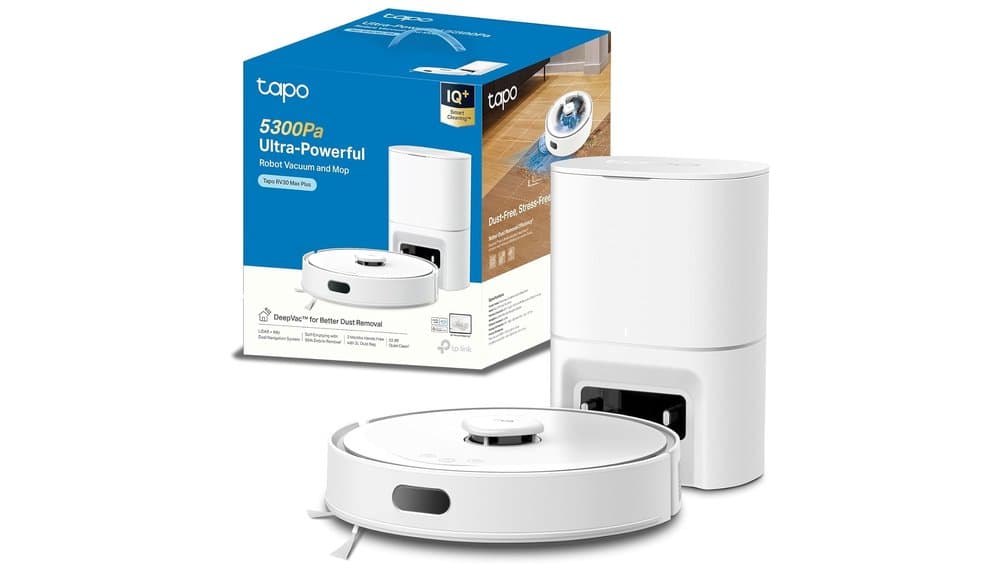
Tapo RV30 Max Plus White Robot Vacuum Cleaner Review
Introduction
In our quest for a healthy interior, free from harsh chemicals, regular and effective vacuuming is one of the fundamental pillars. It helps combat dust, mites, pet dander, and other allergens that accumulate on floors. The Tapo RV30 Max Plus White Robot Vacuum Cleaner positions itself in this approach by promising not only to automate this task but also to add a mopping function. On paper, it presents itself as a valuable ally for maintaining optimal indoor air quality. But what is its true effectiveness against pollutants, its filtration system, and its integration into a health-conscious home? We will dissect its specifications, cross-reference community feedback and technical analyses to give you a clear picture.
Strengths and Weaknesses
Major Strengths
- High Suction Power: With 5300 Pa, it has theoretical power more than sufficient to lift embedded dust and pet hair from hard floors and carpets.
- Exceptional Emptying Autonomy: The automatic emptying station, with its 3L bag, can hold waste for up to 70 days. This is crucial for limiting contact with allergens during maintenance.
- Precision LiDAR Navigation: Reliable laser mapping enables methodical cleaning, avoids collisions, and efficiently manages spaces. The app allows creating no-go zones, notably to protect carpets during mopping.
- Integration into a Chemical-Free Ecosystem: Its 4-in-1 function (simultaneous vacuuming and mopping) makes it a daily maintenance tool that can reduce, or even eliminate, the use of detergents for simple wet dusting.
- Contained Noise Level: With a quiet mode announced at 52 dB, its use is conceivable even with a sleeping baby or for discreet nighttime sessions.
Limitations to Consider
- Filtration Not Specified as "Medical Grade" HEPA: Although equipped with a HEPA filter, the manufacturer does not specify if it is an H13 or H14 HEPA filter. Its actual effectiveness on ultrafine particles (PM2.5, allergens) is therefore not quantified with the precision we seek.
- Passive, Non-Disinfecting Mopping: The mopping pad is fixed and vibrates slightly. It is a cleaning by mechanical action with water, without high temperature (steam) or powerful rotating action. It does not eliminate bacteria or viruses, but removes surface dirt.
- Maintenance of the Mopping System: The water tank and mopping pad must be cleaned and dried manually after each use to prevent the proliferation of mold and bacteria, a potential source of indoor air pollution.
- Limited Mapping: According to user feedback, the robot can manage a limited number of maps (3), which can be a constraint for large multi-story homes.
Detailed Analysis from a Health and Air Quality Angle
Performance Against Allergens and Pollutants
The primary role of the Tapo RV30 Max Plus is to capture solid particles. Its 5300 Pa power, confirmed by users as very effective on pet hair and daily dust, is its main health asset. By regularly removing these deposits, it reduces reservoirs of allergens on which dust mites can thrive.
However, the critical step is the retention of these particles. This is where the filter comes in. The presence of a HEPA filter is a good baseline, but the lack of a clear certification (H13 retains 99.95% of 0.3µm particles, H14 retains 99.995%) prevents us from evaluating it at the level of professional air purifiers. For a household with severe allergies, this is a point to investigate with the manufacturer. The automatic emptying system into a sealed bag is, on the other hand, a huge plus: it confines dust and avoids its re-dispersion into the air during emptying, a often critical moment.
Mopping: A Complement, Not a Disinfection
Its mopping function must be understood as wet dusting. It allows picking up surface dust and residues without making them airborne, thus improving immediate air quality after its passage. It is an excellent complement to vacuuming.
Conversely, it should not be seen as a tool for floor disinfection. No technical data mentions an integrated UV-C lamp in the robot or base, or the production of high-temperature steam. The elimination of bacteria, mold, or viruses on the floor is not part of its functions. Its action is purely mechanical. For ecological disinfection, a separate steam cleaner remains essential.
Noise Level and Daily Use
The figure of 52 dB in quiet mode places it in the category of discreet appliances, comparable to a calm conversation. Users confirm this impression of relatively quiet operation, even at maximum power. This makes it compatible with daytime use without disturbing remote work, or in the early evening. It is an asset for maintaining a high cleaning frequency without nuisance, which is beneficial for ambient air quality.
Cost and Ease of Maintenance
The autonomy of the 3L bag (up to 70 days) is a major argument for simplicity and economy. The cost of replacing these bags will be the main recurring expense, along with HEPA filters and brushes. The ease of access to these consumables is a point to verify over the long term. Regarding mopping, the manual maintenance of the water tank and mopping pad is imperative to avoid creating a source of microbiological contamination. This is a constraint to integrate into the routine.
Technical Specifications
| Characteristic | Detail |
|---|---|
| Suction Power | 5300 Pa |
| Filtration | HEPA filter (grade precision not specified) |
| Min. Noise Level | 52 dB |
| Navigation | LiDAR + anti-drop sensors |
| Functions | Vacuuming, Mopping, Simultaneous Vacuuming+Mopping, Automatic Emptying |
| Battery Life | Up to 150 minutes |
| Robot Dustbin Capacity | Not specified (automatic emptying into station) |
| Station Capacity | 3L dust bag (autonomy ~70 days) |
| Control | Tapo App, Voice Commands (compatible assistants), Child Lock |
| Ecosystem | Integration with other Tapo devices |
What Users and Testers Say
The synthesis of nearly 1900 reviews (overall rating 4.2/5) and available technical analyses paints a clear consensus.
Recurrent praise focuses on:
- Power and Efficiency: "A suction monster", "sucks up pet hair well", "perfect for daily maintenance of an active home". The force of 5300 Pa is tangible for users.
- Intelligence of LiDAR Navigation: The mapping is described as "awesome", "amazing", "ultra-precise". The parallel line movements after room contouring are judged very effective.
- Convenience of Automatic Emptying: This is the life-changing point: "it returns to the base to empty what it has picked up... a time saver". The 3L bag is appreciated for its long autonomy.
- Complete Application: It allows scheduling, dividing into rooms, setting power by zone, and creating no-go zones. Its integration with the Tapo ecosystem (cameras) is a plus for some.
- Value for Money: This is the leitmotif: "Best value for money", "excellent choice for those who want 'premium' level suction without spending €800".
Frequent criticisms and remarks concern:
- Limitations of Mopping: It is systematically described as maintenance cleaning, not deep cleaning. "Does not replace a real mop", "perfect for keeping a floor clean, but it's not professional cleaning".
- Occasional Software Bugs: A few users note issues with automatic map changes or impractical notifications.
- The Map Number Limit: For large homes, the limit of 3 saved maps can be a hindrance.
- The Need for Manual Maintenance: Even with the station, the water tank and mopping pad must be managed manually. Regular cleaning of sensors and brushes (especially with pets) is also emphasized.
Conclusion
The Tapo RV30 Max Plus White Robot Vacuum Cleaner establishes itself as a very convincing tool for the mechanical and regular maintenance of the home, an essential pillar of a healthy indoor environment. Its powerful suction, coupled with the radical convenience of long-autonomy automatic emptying, makes it a first-rate ally for reducing the overall load of allergens (dust, hair) without effort.
However, for our community focused on health and air quality, it is crucial to clearly understand its limits. It is not a mobile air purifier and the exact efficiency of its HEPA filter remains to be certified. It is not a disinfection device; its mopping function is a hygienic complement, not a sterilizing one. Finally, its maintenance (water tank, mopping pad) requires hygienic rigor to avoid secondary contamination.
In summary, if you are looking for a high-performance robot to automate vacuuming and wet dusting, drastically reduce ambient dust and therefore airborne allergens, the Tapo RV30 Max Plus is an excellent candidate, especially given its price positioning. For ecological floor disinfection or active air purification, it will need to be judiciously complemented by dedicated devices like a steam cleaner and a purifier with a certified HEPA filter.
Independent and transparent — Our articles are based on in-depth research and real user reviews. No brand sponsors our content. Affiliate links help fund the site, at no extra cost to you.
Articles you might like
Chicco Humi Hot Advance Air Humidifier Review
Chicco Humi Hot Advance Air humidifier review for kids: warm steam relief for seasonal discomforts in a chemical-free home.
Veegreen White Sage and Palo Santo Incense Set Review
Review the traditional ritual of smudging with white sage and palo santo for cleansing air naturally, as an alternative to modern air purifiers.
NOVEMBER Sirius Mattress Review: Complete Test Analysis
A deep analysis of the NOVEMBER Sirius mattress for healthy sleep. We test its materials and construction for allergens, VOCs, and overall sleep hygiene.
Guides you might like
Air Purifier Buying Guide
Indoor air can be more polluted than outside. Learn how to choose the right air purifier to combat dust, VOCs, and allergens.
Allergen Fighter Dehumidifier Buying Guide
Combat allergies from dust mites and mold caused by high humidity at home. A good dehumidifier protects your family's health.
Anti-allergen vacuum cleaner
Does vacuuming worsen allergies? Yes, with a poor filter. Choose the right vacuum to trap allergens and protect your health.