Weidebach Radiator Brush Micro 125 WB Review & Test
Weidebach Radiator Brush Micro 125 WB Review &
Introduction
In our quest for a healthy indoor environment, we often think of air purifiers, HEPA vacuums, or steam for sanitizing surfaces. But there is a nest for pollutants, often overlooked, that works against our efforts: the radiator. During the heating season, it circulates air and projects into the room a mix of dust, dust mites, pet hair, and fine particles accumulated between its fins. Simply turning on the heat can become a source of indoor pollution and trigger allergies. Effectively cleaning these confined spaces is therefore a crucial step for indoor air quality.
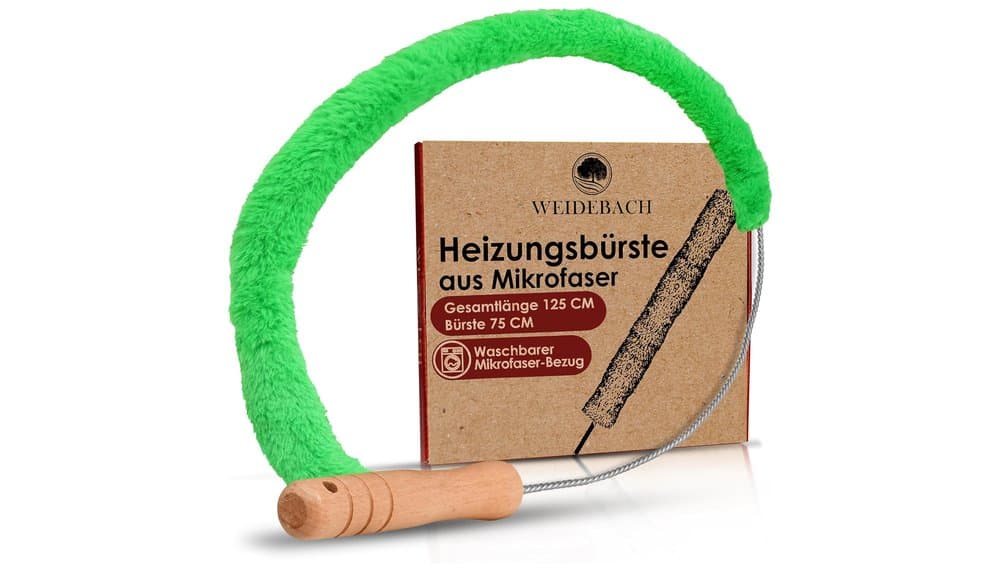
This is where the Weidebach RadiatorBrush-Micro-125-WB comes in. It presents itself as a mechanical and chemical-free solution for clearing out these inaccessible areas. We will analyze this tool in detail to determine if it lives up to its promises regarding pollutant removal, if it is suitable for regular use in a health-conscious household, and what its true strengths and limitations are.
Strengths
- Mechanical and chemical-free cleaning: It allows for the physical removal of allergens and dust without spraying VOCs or irritating substances.
- Surface-friendly design: The rubber-coated shaft and soft microfiber are designed to avoid scratching radiator paint.
- Removable and reusable microfiber cloth: Washable, it limits waste and consumable costs, aligning with a sustainable approach.
- Adapted reach and flexibility: With its 125 cm length and flexible shaft, it promises to reach most angles and depths of standard radiators.
Weaknesses
- Uncertain mechanical strength: Some user feedback points to fragility of the shaft or attachment system under what is considered normal pressure.
- Effectiveness dependent on technique: It's a manual tool whose final result on very sticky dust depends entirely on the user's thoroughness.
- Lack of integrated suction function: Dust is dislodged but falls to the floor or wall, requiring secondary cleaning (vacuum, mop).
- Lack of quantified data: No standardized efficacy test (like a particle removal rate) is provided by the manufacturer.
Detailed Analysis
Impact on Health and Indoor Air Quality
The Weidebach RadiatorBrush-Micro-125-WB adopts a purely mechanical and preventive approach to improving air quality. Its role is not to filter air or kill pathogens, but to eliminate the source of pollution at the root.
According to its description, the microfiber head is designed to capture dust rather than just move it. When used correctly (clean head, slow and deliberate strokes), the electrostatic microfiber can theoretically retain fine particles (PM2.5, PM10), lint, pet hair, and by extension, dust mite allergens and mold spores attached to them. By dislodging these deposits before they are aerosolized by the radiator's hot airflow, the allergenic load in the ambient air is significantly reduced. This is a complementary, not alternative, action to using an air purifier with a HEPA filter.
Unlike a steam cleaner, it does not offer disinfecting power through heat. It does not destroy bacteria or viruses. Its action is strictly dust-removing. For complete sanitization, one would therefore need to, in a second step, use a steam cleaner on the accessible radiator surface or use a vacuum with a HEPA filter to pick up the debris that fell on the floor.
See today's priceEase of Use and Ergonomics
The 125 cm length is a major asset, allowing the cleaning of most wall-mounted radiators without contorting oneself or moving furniture. The advertised flexibility of the shaft is key to adapting to different angles and spaces between the fins. User feedback generally confirms its ability to reach into nooks and crannies.
The noise level is zero, making it a tool perfectly suited for use at any time, including in a baby's room during naps or at night. This is a decisive advantage over a vacuum cleaner, even a quiet one.
However, effectiveness relies on a manual technique. One must anticipate some physical effort for long or very dirty radiators, and accept that some old, caked-on dust may resist. The rubber-coated steel shaft is a positive point for grip and surface protection, but its long-term sturdiness is questioned by part of the community.
Durability and Maintenance
The model promotes a zero-consumable design. The microfiber cover is removable and washable (presumably by hand or in a cold machine wash), which is a major ecological and economic advantage. There are no filters to replace, nor bags to buy. The cost of ownership is therefore limited to the initial purchase and the water and soap for maintaining the head.
The durability of the structure is the main question mark. The advertised materials (steel, rubber) are promising, but the design of the joints and the brush attachment seems to be the weak link reported by some users. Too vigorous handling could lead to premature breakage.
Technical Specifications
| Characteristic | Detail |
|---|---|
| Model Name | Weidebach RadiatorBrush-Micro-125-WB |
| Total Length | 125 cm |
| Head Material | Microfiber |
| Shaft Material | Rubber-coated stainless steel |
| Weight | 190 grams |
| Key Features | Removable and washable head, anti-scratch design, flexible |
| Cleaning Targets | Dust, pet hair, lint in radiator crevices |
| Consumables | None (reusable and washable head) |
What Users and Testers Say
The synthesis of customer reviews and available feedback paints a nuanced but overall positive picture.
The recurring positive points are praiseworthy. A majority of users applaud the product's effectiveness for standard use. Phrases like "Pulisce benissimo !!", "Super czyści" or "Nettoie parfaitement" come up often. They confirm that the brush reaches hard-to-access spots well ("passe anche nei punti più stretti") and that the washable microfiber is highly appreciated for its practicality and economy. The average rating of 4.2/5 from a significant number of reviews supports this.
The critical negative points, although less frequent, are instructive. The main complaint concerns perceived fragility. One user summarizes their experience as "Très fragile !", another as "Ne correspond pas à mon attente", without further details but suggesting an issue with sturdiness or brush attachment. No feedback questions the principle of the tool, but some warn about the robustness of its construction in the long term. There seems to be a variation in perceived quality or a sensitivity to overly rough handling.
Conclusion
The Weidebach RadiatorBrush-Micro-125-WB Radiator Cleaning Brush is a relevant and complementary tool in the arsenal of a household attentive to its indoor air quality. It addresses a real need – the mechanical and chemical-free cleaning of radiators – with convincing arguments: its length, flexibility, washable microfiber head, and absolute silence.
Its effectiveness for reducing sources of allergens and dust is real, provided it is used regularly, before deposits become too stubborn. It does not replace a HEPA vacuum for capturing airborne particles, nor a steam cleaner for disinfecting, but it is their perfect ally by doing the essential preparatory work in otherwise inaccessible areas.
The caveat, raised by part of the community, concerns its mechanical durability. If you are meticulous and willing to handle the tool with care without excessive force, it represents an excellent investment for a healthier home. On the other hand, if your radiators are heavily soiled and require vigorous cleaning, the long-term sturdiness may not match the effort required.
In summary, it's an intelligent and ecological brush that does its basic job well. For the regular and preventive maintenance of your radiators, with a health focus, it largely delivers on its promises.
Independent and transparent — Our articles are based on in-depth research and real user reviews. No brand sponsors our content. Affiliate links help fund the site, at no extra cost to you.