Amazon Basics 700W Cylinder Vacuum Cleaner Review
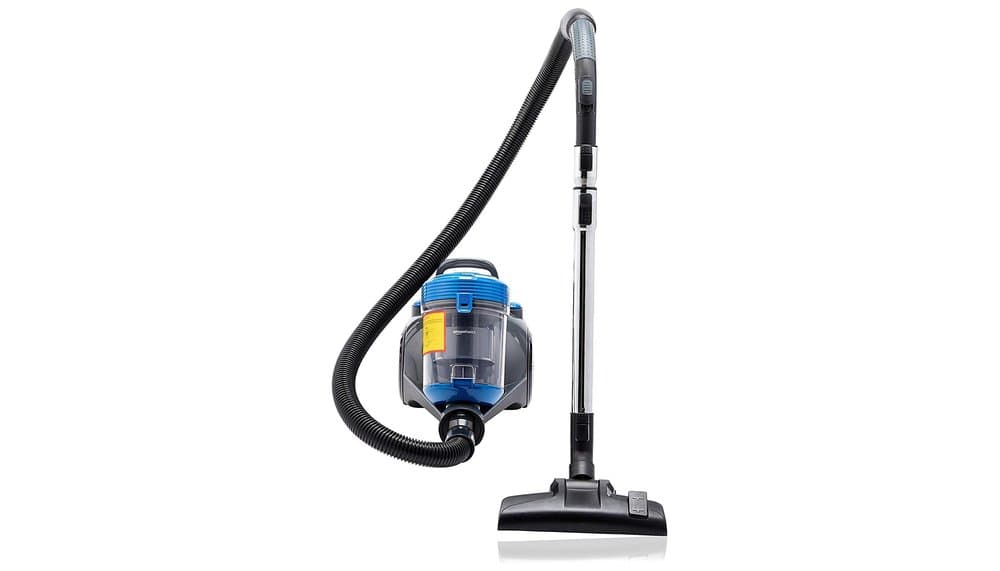
Amazon Basics 700W Cylinder Vacuum Cleaner
Introduction
In our quest for a healthy indoor environment, free of harsh chemicals, choosing our vacuum cleaner is an act that goes far beyond simple cleaning. It's a choice for our respiratory health. The Amazon Basics 700W 2.0L Cylinder Vacuum Cleaner presents itself as an accessible option, promising power and a HEPA filter. But is it an effective ally in the fight against allergens and fine particles that pollute our indoor air? Through an analysis of its specifications, community feedback, and the criteria we hold dear—filtration, air quality, and sound impact—we will separate truth from marketing speak. Is this product capable of helping us create a healthy refuge, or is it simply a basic dusting tool?
Strengths
- Effective HEPA 12 filtration: The washable filter captures over 99.5% of particles, a crucial point for trapping pollen, dust mites, and dander.
- Compact and lightweight design: With a weight of 3.6 kg, it is easy to handle, carry up stairs, and store, ideal for effortless daily use.
- Good value for money: For its performance and feature set, it is often cited as offering excellent value by users.
- Simple, bagless maintenance: The 2-litre dust container empties easily, eliminating the recurring cost of bags, a positive point for the budget and simplicity.
- Contained noise level: Advertised at 72 dBA, it positions itself as quieter than many of its competitors, allowing for more peaceful use.
Weaknesses
- Limited power on thick textiles: Testers point out that suction can lack bite on deep-pile carpets or long-haired rugs, sometimes requiring a reduction in power to prevent the brush head from clogging.
- Economical plastic construction: Some elements, like the power slider or the filter cover, can give an impression of fragility, typical of an entry-level positioning.
- Maneuverability that can be improved near edges: The main brush head can lack precision along skirting boards and in corners, requiring the use of accessories for an impeccable result.
- Power cord sometimes considered short: Although the total reach is 8 meters, some users note that a longer cord would be appreciated for large rooms without having to change power outlets.
- Unavailability of spare parts: The mention "Spare parts not available" in the official specifications raises a question about long-term lifespan and repairability.
Detailed Analysis from a Health and Air Quality Perspective
Filtration Performance: HEPA 12, an Honest Shield
What interests us here is the device's ability to capture pollutants, not just move them around. The Amazon Basics 700W is equipped with a washable HEPA 12 filter. It is essential to understand what this means: the HEPA 12 standard guarantees retention of at least 99.5% of 0.3-micron particles. This includes a vast majority of major allergens: dust mite waste (10 to 20 microns), mold spores (3 to 10 microns), a large part of pollen (10 to 100 microns), and a significant proportion of pet dander (0.5 to 10 microns).
On paper, this is very serious performance for a device at this price. However, two things should be noted. First, the HEPA 12 filter is one step below HEPA H13 or H14 (retention >99.95% and >99.995%), found on vacuums dedicated to severe allergies. Secondly, the real-world effectiveness depends on the system's airtightness. If the bin or seals let unfiltered air pass, particles will be expelled. Reviews do not report problems with "spewing" dust, which is a good sign. Regular maintenance of the filter (cleaning with water) is imperative to maintain this efficiency. The absence of an activated carbon filter means it does not act on VOCs (Volatile Organic Compounds) or odors. For that, a dedicated air purifier is needed.
Impact on Allergens and Fine Dust
In practice, this vacuum is an effective preventive and curative tool for controlling common allergens. Its mechanical action removes a large quantity of debris from surfaces. Thanks to its filtration, it does not re-project them into the air you breathe. This is its main health asset. For a person suffering from mild to moderate allergic rhinitis, it can make a notable difference in the allergenic load of the home. For more severe cases (allergic asthma), although useful, it does not replace a HEPA H13/H14 certified device and a reinforced cleaning protocol.
See today's priceNoise Level: A Discreet Neighbor?
Advertised at 72 decibels (dBA), this level is indeed in the low range for a cylinder vacuum. For comparison, a normal conversation is around 60 dBA. This makes it suitable for daytime use without fear of disturbing the neighbors too much or a baby sleeping in a distant room. However, it will not be quiet enough to vacuum in the same room as a sleeping child. User feedback confirms this impression of a device that is less noisy than average, making it a strength for daily comfort of use.
Power and Capacity: Sufficient for Daily Use
With 700W of power and a 2.0L container, it targets regular use in a small to medium-sized home. The community notes that suction is perfectly satisfactory on hard floors (tiles, hardwood) and low-pile carpets. This is where its potential for healthy cleaning is best exploited. On the other hand, on thick rugs or high-traffic carpets, as some testers point out, the power may show its limits. A vacuum that struggles to extract deeply embedded dust leaves behind a reservoir of allergens. For a household with pets and numerous rugs, it could prove to be more of a supplementary tool than a complete solution.
Design and Maintenance: Simplicity in Service of Hygiene
The bagless system is a double-edged sword. It avoids a recurring cost and is more ecological, but emptying the dust container is potentially the moment most exposed to allergens. It is crucial to do this outside or near an open window, and to wear a mask if one is very sensitive. The ease of disassembly mentioned by users is an advantage here for frequent and complete cleaning, preventing bacterial proliferation inside the container. The compactness is a real plus for easy storage, even in a small cupboard, which encourages frequent use.
Technical Specifications
| Characteristic | Specification |
|---|---|
| Model | Amazon Basics 700W 2.0L Cylinder Vacuum Cleaner |
| Power | 700 W |
| Capacity | 2.0 Litres |
| Filtration | Washable HEPA 12 filter ( >99.5% of 0.3µ particles) |
| Noise Level | 72 dBA |
| Energy Class | A |
| Weight | 3.6 kg |
| Cable Length | 6 m |
| Reach | Approx. 8 m |
| Accessories | Floor brush, dusting brush, crevice tool, integrated holder |
| Features | Bagless, removable container, power adjustment, compact design |
What Users and Testers Say
Analysis of over 32,000 reviews and online expert feedback paints a clear consensus.
The recurring praise revolves around three axes: pleasant surprise at the performance for the price, light weight and maneuverability that make cleaning less tedious, and good efficiency on hard floors. Many describe it as "perfect for an apartment" or an "excellent secondary vacuum." The moderate noise level and HEPA filtration are frequently cited as major assets, especially by those sensitive to dust.
The most common criticisms point to its limitations on thick textiles (carpet, shaggy rugs). Some note that the brush head tends to "catch" on certain floors, reducing smooth operation. The finish quality of the plastics is sometimes judged to be lightweight, and the lack of an integrated storage compartment for accessories is a regret for several users. Finally, the availability of spare parts (filters, brushes) in the long term worries a minority of buyers concerned about durability.
The trend is clear: it is perceived as an honest product that does its basic job well in an urban context or on smooth surfaces, but not as a high-end vacuum for intensive or specialized needs.
Conclusion
The Amazon Basics 700W 2.0L Cylinder Vacuum Cleaner presents itself as a serious and accessible candidate for improving indoor air quality in a standard household. Its HEPA 12 filter is its main health argument, allowing it to effectively capture most household allergens without releasing them into the atmosphere. Combined with a reasonable noise level and exemplary maneuverability, it facilitates regular and thus preventive cleaning.
However, it is important to properly target expectations. It is not a medical-grade vacuum, nor a disinfection tool (it does not generate steam or UV-C). Its power, although sufficient for daily use, may falter against thick carpets, potentially leaving allergens deep within. Its construction reflects its price and its long-term durability will depend on parts availability.
Final verdict: It is an excellent choice for a first vacuum, a home without thick carpeting, or as a primary appliance for a small apartment. For people with mild allergies, looking for a simple and economical solution to reduce their exposure to dust and pollen, it brilliantly fulfills its mission. On the other hand, for homes with pets on thick rugs or for severe respiratory allergies requiring medical-grade filtration, it will be better to invest in a more powerful model equipped with HEPA H13 or H14 filtration. It is, in summary, a benevolent and effective neighbor for routine maintenance, but not the specialist one calls in for the most delicate situations.
Independent and transparent — Our articles are based on in-depth research and real user reviews. No brand sponsors our content. Affiliate links help fund the site, at no extra cost to you.
Articles you might like

Amazon Basics Bagged Cylinder Vacuum Cleaner Review
Amazon Basics bagged vacuum cleaner review: an affordable, simple option for dust and allergen removal, but is it the best for indoor air quality?
Amazon Basics Ultralight Vacuum Cleaner Review & Test
Amazon Basics ultralight bagless vacuum with HEPA filter. Our analysis covers its cleaning power, allergen capture, and overall value for a healthy home.

Amazon Basics Compact Ultralight Vacuum Review
Discover the Amazon Basics Bagless 1.3L vacuum. Ultralight & compact, it targets fine dust and allergens for a chemical-free, healthier clean in your home.
Guides you might like
Anti-allergen vacuum cleaner
Does vacuuming worsen allergies? Yes, with a poor filter. Choose the right vacuum to trap allergens and protect your health.
Guide to the best steam cleaner
Purify your home without chemicals. A steam cleaner eliminates allergens and dirt using only water for a deep, chemical-free clean.