Netatmo Smart Indoor Air Quality Monitor Review & Test
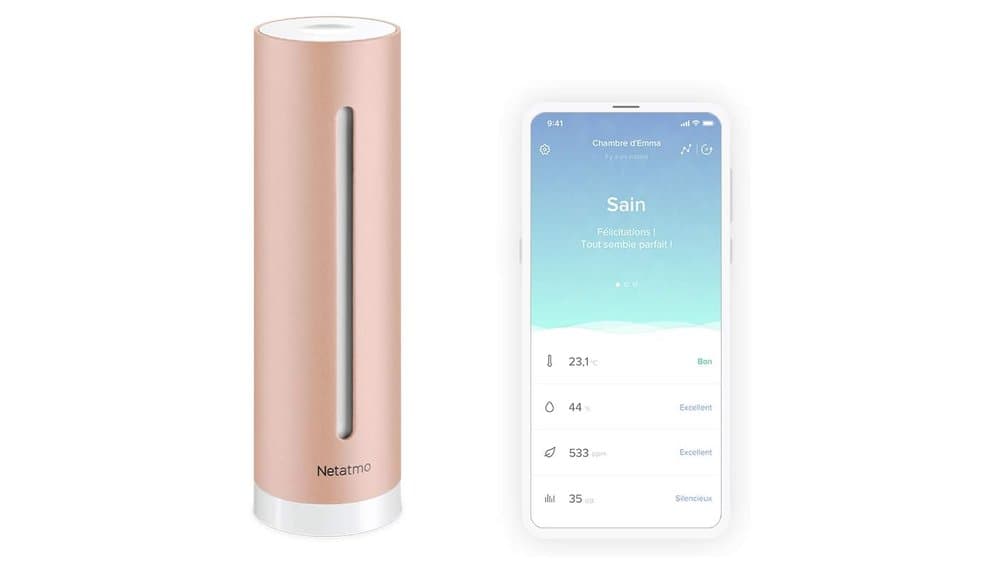
Analysis of the Netatmo Smart Indoor Air Quality Monitor NHC-EC: The Discerning Eye on Your Home's Air
In our quest for a healthier home, where we often talk about what to eliminate – dust, allergens, VOCs – an essential step is sometimes overlooked: diagnosis. How can we know what's wrong if we cannot measure it? The Netatmo Smart Indoor Air Quality Monitor NHC-EC positions itself as the family doctor for your indoor air. It does not purify, does not filter, but it observes, analyzes, and alerts you. For a home free of harsh chemicals, the first step is a fine understanding of its environment. This is precisely the promise of this connected sensor. Let's dive into its operation to see if it holds up its role as a benevolent sentinel.
Strengths
- An integrated CO2 sensor, a major asset for health: This is the most valuable feature. Carbon dioxide (CO2) is a key indicator of air renewal. A high level (beyond 1000-1200 ppm) is directly linked to decreased concentration, headaches, increased fatigue, and poorer sleep quality. Having real-time tracking is revolutionary for managing ventilation.
- Educational application and personalized advice: The Home Coach app doesn't just display numbers. It translates them into actionable advice ("it's time to ventilate", "the air is too dry") and offers dedicated profiles (Baby, Asthmatic Person, General) that adapt alert thresholds. It's a real guide towards better habits.
- Discreet design and home automation integration: Its elegant cylindrical casing and subtle colors (White, Rose Gold) allow it to blend into any interior. Its native integration with Apple HomeKit (and via bridges for other ecosystems) makes it a sensor usable in home automation scenarios (e.g., triggering an MVHR system).
- Data history and no subscription: All your data is recorded locally on an SD card (included) and visible in the application with detailed histories (hour, day, month). This is an asset for identifying trends, like chronic humidity in a room. The service is completely free, with no recurring fees.
Weaknesses
- Lack of sensors for fine particles (PM2.5) and VOCs: This is the most significant limitation from a health perspective. The device does not detect fine particles (allergens, smoke, dust) or Volatile Organic Compounds (fumes from furniture, cleaning products, paints). For a complete analysis of indoor pollution, it needs to be combined with other sensors.
- Total dependence on Wi-Fi and smartphone application: Without a stable 2.4 GHz Wi-Fi connection and a smartphone, the device loses most of its utility. The top LED indicator gives a basic cue (color), but all detailed data and history are inaccessible.
- An investment to multiply for an entire house: Designed for one room, its unit price can deter equipping an entire home. Users considering multi-room monitoring sometimes turn to the Netatmo Weather Station with additional interior modules, potentially more economical.
- Aging Micro-USB connector: In a world that has moved to USB-C, power supply via a Micro-USB cable is noted as an obsolete point by the user community.
Detailed Analysis: Your Interior's Health Assistant
The Sensors and What They Mean For You
The Netatmo NHC-EC relies on four main sensors. Let's analyze what each brings to your quest for healthier air.
The CO2 Sensor is the heart of the device. According to technical specifications, its measurement range goes from 0 to 5000 ppm, which widely covers all domestic situations, even the most saturated ones. Its interest is to make the invisible visible. We cannot feel a CO2 level rising from 800 to 1500 ppm, but our body suffers from it. User feedback is unanimous: this device changes behavior. We ventilate more intelligently, not out of habit, but out of measured need. In a baby's room or for a sensitive person, this data is precious.
The Temperature and Humidity Sensors are of appreciable accuracy (±0.3°C and ±3%). High relative humidity (beyond 60-65%) promotes the growth of mites and mold, two major allergens. Conversely, air that is too dry (below 40%) can irritate the respiratory tract. The monitor then becomes a tool for adjusting the use of a dehumidifier or humidifier, with full knowledge of the facts.
The Sound Meter (measuring noise from 35 to 120 dB) is a more original sensor. Its utility for sleep or concentration is evident. It allows objectifying the noise level of a room, useful for checking if a bedroom is truly quiet, or for measuring the impact of an appliance (like an air purifier) on background noise.
The Application: The Pedagogical Brain
This is where Netatmo excels. The application transforms raw data into actionable information. Visualization in the form of clear graphs allows you to see, for example, that the CO2 level systematically rises during video meetings in the office, or that the bathroom humidity takes over an hour to drop back down after a shower.
The customized profiles are a key function. The "Baby" mode will be stricter on temperature and noise thresholds. The "Asthmatic Person" mode will pay particular attention to humidity. These profiles generate contextualized alerts, more relevant than a generic alarm.
Integration into a "Healthy Home" Approach
This product is the first link in a virtuous chain. It identifies the problem but does not solve it directly. Here's how it articulates with other healthy solutions:
- Detection: The Netatmo alerts you to a too-high humidity level.
- Action: You activate your dehumidifier (or improve ventilation).
- Verification: The curves in the application show you the effectiveness of your action.
- Prevention: The history helps you anticipate and adjust your habits.
For allergens and fine particles, its limit is clear: it does not see them. Its value lies in controlling the favorable conditions (humidity, confinement) for their development or concentration. For direct measurement of PM2.5, an air purifier equipped with a dedicated sensor or a specialized monitor will be necessary.
Technical Specifications
| Parameter | Details |
|---|---|
| Sensors | CO₂, Temperature, Humidity, Noise level |
| CO₂ Measurement Range | 0 to 5,000 ppm |
| Temperature Accuracy | ±0.3°C |
| Humidity Range | 0% to 100% (Accuracy: ±3%) |
| Sound Range | 35 dB to 120 dB |
| Measurement Frequency | Every 5 minutes |
| Connectivity | Wi-Fi 2.4 GHz only |
| Smart Home Ecosystem | Native Apple HomeKit. No native Alexa/Google Assistant support. |
| Power Supply | Mains power (Micro-USB cable included) |
| Data Storage | Local (SD card included) - No mandatory cloud |
| Application | Netatmo Home Coach (free, iOS & Android) |
| Custom Profiles | Yes (Baby, Sensitive/Asthmatic Person, General) |
What Users and Reviewers Say
A synthesis of available customer reviews and expert feedback draws a solid consensus around this product.
The recurrent praises concern:
- The concrete impact on habits: Many users report that they now ventilate their homes more effectively and thoughtfully. The phrase "You realize the indoor pollution" often comes up. Many note an improvement in their sleep quality and a reduction in headaches.
- The reliability and accuracy of measurements: The data provided is judged to be consistent and credible. Long-term stability is praised, with some users reporting flawless operation after several years.
- The simplicity and effectiveness of the application: The interface is described as intuitive, the graphs clear, and the notifications useful. The lack of a subscription is a major and much-appreciated point.
- The discreet design and integration: Its appearance is perceived as an asset, allowing installation in any room without harming the decor.
The most frequent criticisms concern:
- The lack of compatibility with other Netatmo ecosystems: It is regretted that this sensor does not integrate directly with the Netatmo thermostat or the weather station for more advanced automated management.
- The need for a robust Wi-Fi connection: Some reports mention intermittent disconnections in areas with poor coverage, rendering the device temporarily "silent".
- The absence of fine particle (PM2.5) measurement: For users most concerned about air quality, this absence is a real shortcoming, even though CO2 remains the primary indicator of confinement.
- Occasional firmware/update issues: Some isolated reports mention difficulties during setup, requiring manual firmware manipulation via computer.
Conclusion: An Illuminating Investment for a Healthier Home
The Netatmo Smart Indoor Air Quality Monitor NHC-EC is not an air purifier. It does not replace a HEPA filter or the action of a steam cleaner. On the other hand, it is an indispensable tool for knowledge and awareness.
Its great merit is to demystify the indoor environment by quantifying it. It answers fundamental questions: "When should we really ventilate?", "Is my humidity level conducive to mites?", "Is my bedroom quiet enough for restorative sleep?".
For a health-conscious family, particularly with a baby, asthmatic individuals, or allergy sufferers, it represents a precious aid. It objectifies parameters that directly influence daily well-being. Its CO2 sensor is its strongest health asset, allowing effective fight against confinement, a source of many discomforts.
Its main limitation – the absence of fine particle and VOC measurement – must be known. It is the specialist in comfort and air renewal, not in particulate pollution tracking. In a global approach, it can perfectly coexist with an air purifier equipped with its own sensors.
Ultimately, if you are looking to understand and act on the fundamentals of your indoor air (confinement, humidity, temperature) with a reliable, well-designed, and educational tool, the Netatmo NHC-EC perfectly fulfills its role as a benevolent "home coach". It gives you the keys to make the right decisions, towards a healthier and more comfortable home for all.
Independent and transparent — Our articles are based on in-depth research and real user reviews. No brand sponsors our content. Affiliate links help fund the site, at no extra cost to you.
Articles you might like
NNOVAT Puff Chill Smoking Fan Portable Air Purifier Review
Compact portable air purifier for smoke & odors. Filters air in real-time like a table fan.
Rolipo TMSC-001 Steam Cleaner Test & Review
Decide if the Rolipo TMSC-001 steam cleaner is right for your healthy cleaning routine to eliminate allergens and bacteria with just water and heat.
Vacmaster VQ1220SC Wet Dry Vacuum Review & Test
Discover the Vacmaster VQ1220SC, a powerful wet-dry vacuum cleaner. We analyze its real-world impact on dust, allergens, and home air quality.
Guides you might like
Air Purifier Buying Guide
Indoor air can be more polluted than outside. Learn how to choose the right air purifier to combat dust, VOCs, and allergens.
Allergen Fighter Dehumidifier Buying Guide
Combat allergies from dust mites and mold caused by high humidity at home. A good dehumidifier protects your family's health.

Anti-allergen vacuum cleaner
Does vacuuming worsen allergies? Yes, with a poor filter. Choose the right vacuum to trap allergens and protect your health.